Showing posts with label USSR - Soyuz. Show all posts

1975-05-24 USSR Soyuz 18

A Soyuz 18 First Day Cover from "KNIGA", postmarked in Moscow with a hand cancel on September 12, 1975, signed by Pyotr Klimuk and Vitaly Sevastyanov.
Soyuz 18 was launched from Baikonur on May 24, 1975, carrying cosmonauts Pyotr I. Klimuk (commander) and Vitaly I. Sevastyanov (flight engineer). Their mission was to continue the scientific and engineering work begun by the first crew of Salyut 4, Soyuz 17. NASA records the mission as the second crewed expedition to Salyut 4, lasting more than 62 days.

Only six weeks earlier, on April 5, 1975, another Soyuz spacecraft carrying Vasili Lazarev and Oleg Makarov had suffered a launch-vehicle failure and was forced to make an emergency abort. Klimuk and Sevastyanov, who had been the backup crew, were subsequently assigned to fly Soyuz 18.

A Soyuz 18 docking with the Salyut 4 space station cover, postmarked in Moscow on May 25, 1975, signed by Pyotr Klimuk and Vitaly Sevastyanov.
Salyut 4 was one of the early Soviet long-duration orbital space stations. Soyuz 17 had occupied it earlier in 1975, and Klimuk and Sevastyanov became its second and final crew. Soyuz 18 crew conducted approximately 90 scientific and engineering experiments during their stay. Their mission lasted approximately 63 days, establishing a new Soviet endurance record at the time.

In fact, while Soyuz 18 was operating aboard Salyut 4, the Apollo-Soyuz crews were preparing for their historic rendezvous. During the Apollo-Soyuz mission in July, the five ASTP astronauts and cosmonauts communicated with Klimuk and Sevastyanov aboard Salyut 4. This temporarily brought the number of people in space to seven, tying the record for the largest number of humans simultaneously in orbit at that time. NASA notes that Klimuk jokingly referred to them as the "magnificent seve".

1975-01-11 USSR Soyuz 17

A Soyuz 17 First Day Cover from "KNIGA", postmarked in Moscow with a hand cancel on March 28, 1975, signed by Aleksei Gubarev and Georgy Grechko.
Soyuz 17 was the first crewed expedition to the Soviet Salyut 4 space station. The spacecraft launched from Baikonur on January 10, 1975 UTC (January 11 Moscow time), carrying Aleksei Gubarev as commander and Georgy Grechko as flight engineer. The two men successfully docked with Salyut 4 on January 12. Salyut 4 had been launched on December 26, 1974, only a few weeks earlier. It was a second-generation Soviet space station with improved solar-power capabilities and was intended for extended scientific research in orbit.

Gubarev and Grechko remained aboard Salyut 4 for almost 30 days, from January 12 until February 9, 1975. Their mission lasted 29 days, 13 hours, 19 minutes, establishing a new Soviet human-spaceflight endurance record.

1974-12-02 USSR Soyuz 16

A Soyuz 16 First Day Cover from "KNIGA", postmarked in Moscow with a hand cancel on March 28, 1975, signed by Anatoly Filipchenko and Nikolai Rukavishnikov.
Soyuz 16 was launched from Baikonur on December 2, 1974, carrying Soviet cosmonauts Anatoly Filipchenko and Nikolai Rukavishnikov. It was essentially a full-scale dress rehearsal for the Soviet portion of the Apollo-Soyuz Test Project (ASTP), which was scheduled for July 1975.

The spacecraft incorporated modifications that would be needed for the joint U.S.–Soviet mission, including an experimental docking system and changes to its life-support system. The crew also tested the spacecraft under atmospheric conditions designed to make transfers between Soyuz and Apollo safer and faster.

A Soyuz 16 US/USSR joint tracking exercise cover, postmarked at Houston, Texas, with a machine cancel on December 3, 1974.
On December 3, 1974, NASA began a joint U.S.–Soviet tracking exercise using Soyuz 16. NASA's Spaceflight Tracking and Data Network (STDN) began tracking the spacecraft shortly after its launch. Data obtained by nine U.S. tracking stations was to be compared with data gathered by Soviet tracking stations. This was intended to verify that the two countries could independently track the spacecraft and exchange the information necessary for the rendezvous and docking operations planned for Apollo-Soyuz.

The simulated docking operations on December 5–7 were successful, and the spacecraft returned to Earth on December 8, 1974. NASA subsequently regarded the mission as an important rehearsal for the Soviet side of Apollo-Soyuz.

A Soyuz 16 recovery cover, postmarked in Moscow with a hand cancel on December 8, 1974, signed by Anatoly Filipchenko and Nikolai Rukavishnikov. It features a hand-painted cachet by artist Detlev Van Ravenswaay.

1974-08-26 USSR Soyuz 15

A Soyuz 15 First Day Cover from "KNIGA", postmarked in Moscow with a hand cancel on October 18, 1974, signed by Gennadi Sarafanov and Lev Dyomin.
Soyuz 15, launched on August 26, 1974, was a Soviet crewed mission to the Salyut 3 space station. The two-person crew consisted of Gennadi Sarafanov (Commander) and Lev Dyomin (Flight Engineer). It was the second crewed flight intended to visit Salyut 3, following the successful Soyuz 14 mission the previous month. Unlike Soyuz 14, however, Soyuz 15 was unable to dock with the station.

On August 27, Soyuz 15 approached Salyut 3 using the Igla automatic rendezvous and docking system. The spacecraft got very close to the station, but the Igla system developed serious problems during the final approach. With limited propellant and electrical power available on the Soyuz, repeated attempts to rendezvous were not practical. The crew therefore had to abandon the planned station mission and prepare for an early return to Earth.

A Soyuz 15 recovery cover, postmarked in Moscow with a hand cancel on August 28, 1974.
Another problem appeared during preparations for reentry: gyroscope difficulties complicated the spacecraft's orientation for the deorbit maneuver. The crew nevertheless succeeded in returning safely. Soyuz 15 landed on August 28, 1974, after a flight lasting approximately 48 hours 12 minutes. It was notable as the first Soviet nighttime landing, and the landing occurred under difficult weather conditions, including a lightning storm.

1974-07-03 USSR Soyuz 14

A Soyuz 14 launch cover, postmarked in Moscow with a hand cancel on July 3, 1974, signed by Pavel Popovich and Yuri Artyukhin.
Soyuz 14, launched from Baikonur Cosmodrome on July 3, 1974, was a major Soviet crewed-spaceflight milestone: it carried Pavel Popovich and Yuri Artyukhin to the newly launched Salyut 3 space station and became the first successful Soviet crewed mission to occupy that station. Popovich was already an experienced cosmonaut, having flown Vostok 4 in 1962. Artyukhin was making his first spaceflight.

A cover featuring Soyuz 14 docking with the space station Salyut 3, postmarked in Moscow with a hand cancel on July 4, 1974, signed by Pavel Popovich and Yuri Artyukhin.
The destination was Salyut 3, launched only nine days earlier, on June 25, 1974. Soyuz 14 initially encountered some difficulty during the rendezvous because the crew had trouble using the spacecraft's optical sighting device. Nevertheless, the spacecraft successfully approached the station and docked on July 5. Popovich and Artyukhin then transferred into Salyut 3, where they spent the majority of their mission. The mission wasn't simply a transportation flight to a space station. It was an extensive test of the station, its equipment, and the ability of a crew to live and work there.

A Soyuz 14 First Day Cover from "KNIGA", postmarked in Moscow with a hand cancel on October 18, 1974, signed by Pavel Popovich and Yuri Artyukhin.
After more than two weeks aboard Salyut 3, the crew departed the station and returned to Earth on July 19, 1974. Soyuz 14 landed in Kazakhstan, approximately 140 km southeast of Dzhezkazgan. Total mission duration was 15 days 17 hours 30 minutes, with about 252 orbits according to mission records.

1973-12-18 USSR Soyuz 13

A Soyuz 13 launch cover, postmarked in Moscow with a hand cancel on December 18, 1973, signed by Pyotr Klimuk and Valentin Lebedev.
Soyuz 13, launched from Baikonur Cosmodrome on December 18, 1973, was a particularly interesting Soviet crewed mission because it was not a space-station expedition. Instead, the spacecraft was specially modified to serve as a manned astronomical observatory, carrying the Orion-2 telescope. The crew consisted of Pyotr Ilyich Klimuk (Commander) and Valentin Vitalyevich Lebedev (Flight Engineer), both were making their first spaceflight.

A Soyuz 13 First Day Cover from "KNIGA", postmarked in Moscow with a hand cancel on March 27, 1974, signed by Pyotr Klimuk and Valentin Lebedev.
The most important feature of Soyuz 13 was the Orion-2 astrophysical observatory. Engineers modified the normal Soyuz configuration by removing the forward docking equipment and installing the telescope package in its place. This allowed the spacecraft to be devoted primarily to astronomical observations rather than rendezvous or docking. The telescope's principal objective was to study stars in the ultraviolet portion of the spectrum, roughly 2,000–3,000 Å. This was scientifically important because Earth's atmosphere absorbs much of the ultraviolet radiation from celestial objects, making observations from Earth difficult or impossible. The mission obtained ultraviolet spectra of numerous stars and other celestial objects, providing information that could not readily be obtained from ground-based observatories. Soyuz 13 was more than an astronomy mission, it combined astronomy, biology, Earth observation and human-spaceflight research in a relatively short autonomous flight.

1973-09-27 USSR Soyuz 12

A Soyuz 12 launch cover, postmarked in Moscow with a hand cancel on September 27, 1973, signed by Vasily Lazarev and Oleg Grigoryevich Makarov.
Soyuz 12, launched from Baikonur Cosmodrome on September 27, 1973, was a pivotal Soviet crewed mission. It was the first crewed flight of the redesigned Soyuz spacecraft after the Soyuz 11 tragedy in 1971, and its primary purpose was to test the new spacecraft and the safety measures introduced as a result of that accident. The crew consisted of Vasily Lazarev (Commander) and Oleg Grigoryevich Makarov (Flight Engineer). The mission lasted 1 day, 23 hours, 15 minutes, ending with a safe landing in Kazakhstan on September 29.

A Soyuz 12 First Day Cover from "KNIGA", postmarked in Moscow with a hand cancel on March 27, 1974, signed by Vasily Lazarev and Oleg Grigoryevich Makarov.
The background to Soyuz 12 goes back to Soyuz 11, which returned from Salyut 1 in June 1971. Its three cosmonauts—Georgy Dobrovolsky, Vladislav Volkov and Viktor Patsayev — died during the return to Earth when the spacecraft's descent module lost cabin pressure. The accident resulted in a major redesign of the Soyuz spacecraft. The most obvious operational change was that the crew was reduced from three to two. This provided enough room for the cosmonauts to wear pressure suits during launch and landing.

One of the most significant changes tested on Soyuz 12 was the introduction of the Sokol pressure suit. The cosmonauts wore the suits during launch and descent, although they did not wear them during normal orbital operations. The suit was designed to protect the crew in the event of cabin depressurization. Soyuz 12 was therefore much more than another routine Soviet spaceflight — it was effectively a crewed checkout of the post-Soyuz-11 safety redesign.

1971-06-06 USSR Soyuz 11

A Soyuz 11 launch cover from "Swanson", postmarked in Moscow with a hand cancel on June 6, 1971.
Soyuz 11 was one of the most significant — and tragic — missions in early space-station history. Launched from the Baikonur Cosmodrome on June 6, 1971, it carried Georgi Dobrovolski, Vladislav Volkov, and Viktor Patsayev to Salyut 1, the world's first space station.

Photo: The Soyuz 11 crew, featuring Georgi Dobrovolski (left), Vladislav Volkov (right), and Viktor Patsayev (in the background).
Soyuz 11 was the Soviet Union's second attempt to send a crew to Salyut 1. The first, Soyuz 10, had docked unsuccessfully in April and its crew could not enter the station. Soyuz 11 successfully docked with Salyut 1 on June 7, 1971. The three cosmonauts then became the first humans to occupy a space station. They spent approximately 23 days aboard Salyut, conducting scientific, medical, astronomical, Earth-observation, and engineering experiments.

A cover from "Swanson" featuring Soyuz 11 docking with the space station Salyut 1, postmarked in Moscow with a hand cancel on June 7, 1971, signed by Carl A. Swanson, the cover’s producer.
Among the work performed was operation of the Orion-1 ultraviolet telescope, biological experiments, studies of the human body's response to prolonged weightlessness, and experiments involving plant growth. The crew also exercised regularly to counter the effects of extended weightlessness. The mission was also a remarkable endurance achievement at that time: Soyuz 11 established a new human spaceflight duration record of nearly 24 days.

A Soyuz 11 recovery cover from "Swanson", postmarked in Moscow with a hand cancel on June 30, 1971, signed by Carl A. Swanson, the cover’s producer.
During the preparation for atmospheric reentry, the Soyuz descent module unexpectedly lost cabin pressure. A pressure-equalization valve, which was supposed to open only later during descent, was accidentally opened when the spacecraft's modules separated. The cabin atmosphere escaped into space in roughly 30 seconds. The cosmonauts were not wearing pressure suits. They lost consciousness rapidly and died before the spacecraft completed its automatic reentry. The capsule landed normally in Kazakhstan on June 30, 1971, and recovery personnel discovered all three men dead inside.

A Soyuz 11 First Day Cover from "KNIGA", postmarked in Moscow with a hand cancel on October 20, 1971.
(Reference from Soyuz 11)

1971-04-23 USSR Soyuz 10

A Soyuz 10 launch cover from "KNIGA", postmarked in Moscow with a hand cancel on April 23, 1971, signed by Vladimir Shatalov, Aleksei Yeliseyev, Nikolai Rukavishnikov.
Soyuz 10 was the first crewed mission to attempt a rendezvous and docking with Salyut 1, the world's first space station. It launched from Baikonur on April 23, 1971, just four days after Salyut 1 itself had been placed into orbit. The crew consisted of Vladimir Shatalov, Aleksei Yeliseyev, and Nikolai Rukavishnikov.

On April 24, Soyuz 10 approached Salyut 1. The automatic rendezvous system brought the spacecraft close to the station, after which commander Shatalov manually took control and completed the docking maneuver. The two spacecraft were physically connected for about 5½ hours. However, the docking mechanism did not achieve the required hard docking. Because the connection was incomplete, the crew could not open the hatch and transfer from Soyuz 10 into Salyut 1. This meant that, although Soyuz 10 technically achieved a docking, it did not become the first crew to enter and live aboard a space station.

A Soyuz 10 docking with Salyut 1 cover from “KNIGA,” postmarked in Moscow with a hand cancel on April 24, 1971, signed by cosmonauts Vladimir Shatalov, Aleksei Yeliseyev, and Nikolai Rukavishnikov.
The problem was particularly frustrating because Soyuz 10 had been intended to spend about a month aboard Salyut 1. With the crew unable to enter the station and their spacecraft's supplies limited, mission control decided to terminate the mission. Before leaving, the crew flew around Salyut 1 and photographed its docking area to help engineers determine what had gone wrong. They successfully returned to Earth on April 25, making the Soviet space program's first night landing.

1970-06-01 USSR Soyuz 9

A Soyuz 9 First Day Cover from "KNIGA", postmarked in Moscow with a hand cancel on July 7, 1970, signed by Andriyan Nikolayev and Vitali Sevastyanov.
Soyuz 9 was a Soviet crewed spaceflight launched on June 1, 1970, carrying cosmonauts Andriyan Nikolayev and Vitali Sevastyanov. The mission focused on studying the effects of prolonged spaceflight on the human body and testing crew procedures and spacecraft systems for future long-duration missions and space stations. Soyuz 9 remained in orbit for 17 days, 16 hours, and 59 minutes, returning to Earth on June 19, 1970. At the time, it was the longest crewed spaceflight ever completed, surpassing the nearly 14-day endurance record set by the U.S. Gemini 7 mission in 1965.

During their record-setting mission, the cosmonauts completed hundreds of orbits while conducting a wide range of biomedical, biological, geological, and meteorological experiments, along with observations and photography of Earth and the Sun. They also performed daily physical exercises using specially designed load suits to help counter the effects of prolonged weightlessness. After nearly 18 days in orbit, Soyuz 9 successfully landed on June 19, approximately 76 kilometers west of Karaganda, Kazakhstan.

1969-10-13 USSR Soyuz 8

A Soyuz 8 First Day Cover from "KNIGA", postmarked in Moscow with a hand cancel on October 22, 1969, signed by Vladimir Shatalov and Aleksei Yeliseyev.
Soyuz 8 was the third spacecraft in the group flight, launching from Baikonur on October 13, 1969, with Vladimir Shatalov and Aleksei Yeliseyev aboard. Its principal objective was to rendezvous with Soyuz 7 and carry out the planned docking and crew-transfer operation, while Soyuz 6 was positioned nearby to observe and photograph the maneuver.

Soyuz 8 successfully rendezvoused with Soyuz 7, but the two spacecraft were unable to dock because the Igla automatic rendezvous system failed to establish the necessary communications between the spacecraft. The mission nevertheless provided valuable experience in orbital maneuvering and coordinated flight. Soyuz 8 returned to Earth on October 18, 1969, completing a mission lasting 4 days, 22 hours, and 50 minutes.

Photo: The seven cosmonauts from Soyuz 6, 7 and 8 missions.

1969-10-12 USSR Soyuz 7

A Soyuz 7 First Day Cover from "KNIGA", postmarked in Moscow with a hand cancel on October 22, 1969, signed by Anatoly Filipchenko, Vladislav Volkov and Viktor Gorbatko.
Soyuz 7 launched from Baikonur on October 12, 1969, one day after Soyuz 6, with Anatoly Filipchenko, Vladislav Volkov, and Viktor Gorbatko aboard. Its primary role was to participate in the three-spacecraft group flight and to conduct a rendezvous and planned docking with Soyuz 8, with the possibility of transferring cosmonauts between the two spacecraft.

Soyuz 7 successfully maneuvered toward Soyuz 8, approaching to approximately 460 meters, but the spacecraft could not complete the planned docking because of problems with the rendezvous and docking system. Despite this setback, the mission demonstrated coordinated operations between multiple crewed spacecraft and included scientific, technical, and Earth-observation experiments. Soyuz 7 landed in Kazakhstan on October 17, 1969, after approximately 4 days, 22 hours, and 40 minutes in orbit.

1969-10-11 USSR Soyuz 6

A Soyuz 6 First Day Cover from "KNIGA", postmarked in Moscow with a hand cancel on October 22, 1969, signed by Georgy Shonin and Valeri Kubasov.
Soyuz 6 was launched from Baikonur on October 11, 1969, carrying cosmonauts Georgi Shonin and Valeri Kubasov. It was the first of three Soviet crewed spacecraft launched in consecutive days as part of a complex group flight. One of its principal objectives was to test welding techniques in the vacuum of space. Kubasov operated the experimental Vulkan welding apparatus inside the spacecraft's depressurized orbital module, testing several methods that could eventually be useful for construction and repair work aboard future space stations.

Soyuz 6 was also intended to observe and photograph the planned rendezvous and docking of Soyuz 7 and Soyuz 8. However, problems with the rendezvous systems prevented the docking from taking place. The spacecraft nevertheless carried out various engineering, scientific, and biomedical experiments while operating alongside the other two Soyuz spacecraft. Soyuz 6 returned to Earth on October 16, 1969, after 4 days, 22 hours, and 42 minutes in orbit.

1969-01-14 USSR Soyuz 4 and 5

A Soyuz 4 and 5 First Day Cover from "KNIGA", postmarked in Moscow with a hand cancel on January 22, 1969, signed by Vladimir Shatalov, Boris Volynov, Aleksei Yeliseyev and Yevgeny Khrunov.
Soyuz 4 was launched from Baikonur on January 14, 1969, carrying cosmonaut Vladimir Shatalov, who was making his first spaceflight. Soyuz 4 was the active spacecraft in a planned rendezvous and docking with Soyuz 5, which was launched the following day. Soyuz 5 launched from Baikonur on January 15, 1969, carrying cosmonauts Boris Volynov, Yevgeny Khrunov, and Aleksei Yeliseyev.

On January 16, Soyuz 4 successfully rendezvoused with Soyuz 5 and completed the first docking between two crewed spacecraft. Because the docking system did not provide an internal passageway between the spacecraft, cosmonauts Yevgeny Khrunov and Aleksei Yeliseyev transferred from Soyuz 5 to Soyuz 4 by performing a spacewalk. After spending about an hour outside the spacecraft, they entered Soyuz 4 and joined Shatalov. The two spacecraft remained docked for approximately 4 hours and 35 minutes before separating. After the transfer, Soyuz 5 separated from Soyuz 4 with Volynov aboard.

Soyuz 4 returned to Earth on January 17, 1969, carrying Vladimir Shatalov, Yevgeny Khrunov, and Aleksei Yeliseyev. Soyuz 5, with Boris Volynov aboard, remained in orbit until January 18. During its descent, the service module failed to separate properly from the reentry module, causing the spacecraft to enter the atmosphere in an abnormal orientation. The modules eventually separated under aerodynamic forces, allowing the descent module to orient itself correctly for reentry. Volynov survived the difficult landing and was recovered safely in Kazakhstan.

1968-10-26 USSR Soyuz 3

A Soyuz 3 First Day Cover from "KNIGA", postmarked in Moscow with a hand cancel on December 14, 1968, signed by Georgy Beregovoy.
Soyuz 3 was launched from the Baikonur Cosmodrome on October 26, 1968, carrying cosmonaut Georgi Beregovoy. It was the first crewed Soviet spaceflight since the fatal Soyuz 1 mission in April 1967 and served as an important test of the redesigned Soyuz spacecraft.

The mission's main objective was to rendezvous and dock with the uncrewed Soyuz 2, which had been launched the previous day as a target spacecraft. The automatic rendezvous system brought Soyuz 3 to within about 180–200 meters of Soyuz 2, after which Beregovoy took manual control and maneuvered to within approximately one meter. However, the spacecraft could not complete the planned docking because of alignment and control problems.

After the unsuccessful docking attempts, Beregovoy continued with topographical and meteorological observations and other experiments during the remainder of the mission. He completed 81 orbits during approximately 3 days, 22 hours, and 51 minutes in space. Soyuz 3 landed safely in Kazakhstan on October 30, 1968, with the redesigned spacecraft and parachute system performing successfully.

1967-04-23 USSR Soyuz 1

A Soyuz 1 launch cover postmarked in Kaluga with a hand cancel on on April 23, 1967.
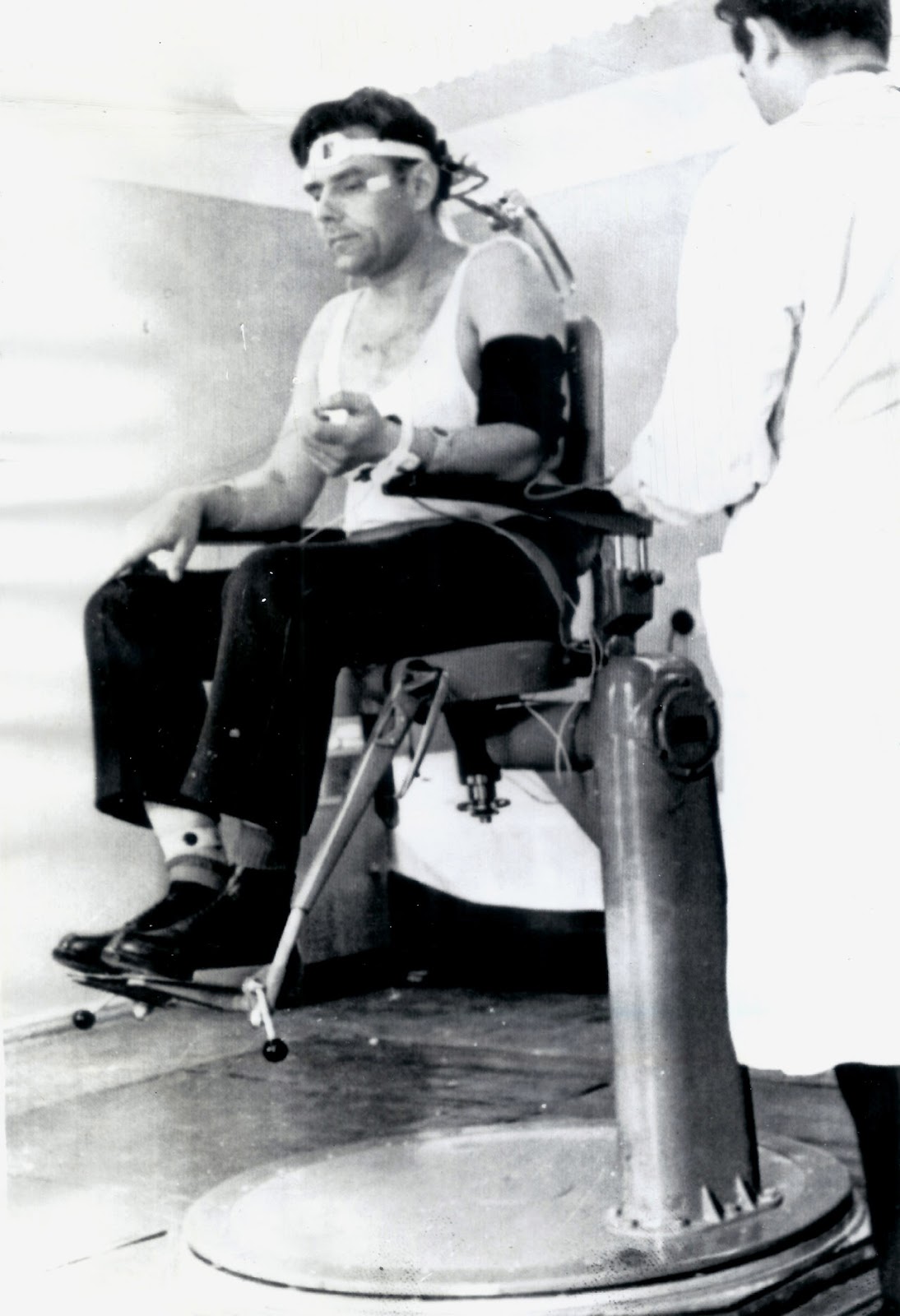
Soyuz 1 was launched from the Baikonur Cosmodrome on April 23, 1967, carrying cosmonaut Vladimir Komarov on the first crewed flight of the new Soyuz spacecraft. The mission was intended to test the spacecraft in crewed flight and to conduct a rendezvous and docking with Soyuz 2, which was scheduled to launch the following day with three cosmonauts. Two of the Soyuz 2 crew were then expected to transfer to Soyuz 1 by spacewalk.

Photo: This image published by an official Communist news agency, shows veteran cosmonaut Vladimir Komarov undergoing a medical test prior to his space mission on April 23, 1967.
Soon after reaching orbit, Soyuz 1 experienced serious technical problems. One of its two solar panels failed to deploy, leaving the spacecraft with insufficient electrical power, while problems with the orientation system made maneuvering difficult. As a result, the planned Soyuz 2 launch was cancelled and Komarov was ordered to return to Earth. After an unsuccessful automated reentry attempt, he manually oriented the spacecraft and successfully initiated the descent during the 18th orbit.

A Soyuz 1 launch cover postmarked in Liepaja with a hand cancel on April 23, 1967.
The reentry itself was successful, but the parachute system failed during descent. The main parachute did not deploy properly, and the reserve parachute became tangled with the malfunctioning system. The descent module subsequently crashed in the Orenburg region of the Soviet Union on April 24, 1967, killing Komarov. He became the first human to die during a spaceflight. The accident led to extensive redesign and uncrewed testing of the Soyuz spacecraft before crewed flights resumed with Soyuz 3 in October 1968.

Photo: Colonel Vladimir Komarov, who lost his life during the Soyuz 1 mission when his descent module crashed to the ground because of a parachute failure.