Showing posts with label US - Vanguard. Show all posts

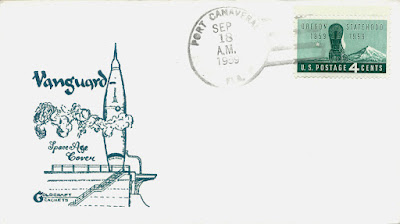
1959-09-18 USA Vanguard 3

Vanguard 3 played a significant role in the Space Race between the U.S. and the Soviet Union. Launched on September 18, 1959, from the Eastern Test Range of the Atlantic Missile Range at Cape Canaveral, it entered a geocentric orbit. The mission aimed to measure the Earth's magnetic field, solar X-ray radiation and its impact on the Earth's atmosphere, the near-Earth micrometeoroid environment, as well as the drag effects and density of the upper atmosphere. The spacecraft was equipped with a proton magnetometer, X-ray ionization chambers, radio transmitters, and various micrometeoroid detectors. The data collected provided a detailed survey of the Earth's magnetic field in the region, defined the lower boundary of the Van Allen radiation belt, and recorded micrometeoroid impacts. Vanguard 3 is expected to remain in orbit for about 300 years.

Vanguard 3 launch cover with Goldcraft cachet
(Reference from Vanguard 3)

1959-02-17 USA Vanguard 2

Vanguard 2 is a U.S. Earth-orbiting satellite that was launched on February 17, 1959, at 15:55:02 GMT, aboard a Vanguard SLV-4 rocket as part of the United States Navy's Project Vanguard. Its primary purpose was to measure cloud cover distribution during the daylight portion of its orbit for a duration of 19 days and to provide data on atmospheric density for the expected lifespan of its orbit, which is approximately 300 years. As the first weather satellite and one of the earliest orbital space missions, the launch of Vanguard 2 marked a significant milestone in the Space Race between the United States and the Soviet Union.

Vanguard 2 "Goldcraft" launch cover postmarked at Port Canaveral on February 17, 1959.
Vanguard 2 "Sarzin" launch cover postmarked at Port Canaveral on February 17, 1959.
(Reference from Vanguard 2)

1958-03-17 USA Vanguard 1

Vanguard 1 is a U.S. satellite that became the fourth artificial Earth-orbiting satellite when it was launched on March 17, 1958, after Sputnik 1, Sputnik 2, and Explorer 1. As the first solar-powered satellite, Vanguard 1 was intended to test the launch capabilities of a three-stage launch vehicle as part of Project Vanguard, as well as to study the effects of the space environment on a satellite and its systems in Earth orbit.

Vanguard 1 "Goldcraft" launch cover, postmarked at Patrick Air Force Base on March 17, 1958.
Vanguard 1 launch cover from "H.Flick", postmarked at Patrick Air Force Base on March 17, 1958.
Vanguard 1 "Sarzin" launch cover, postmarked at Port Canaveral on March 17, 1958.
(Reference from Vanguard 1)