Showing posts with label US - Surveyor. Show all posts

1968-01-07 USA Surveyor 7

"SpaceCraft" Surveyor 7 launch cover cancelled at Cape Canaveral, January 7, 1968. Signed by Surveyor Project Manager, Robert J. Parks
Surveyor 7 landed in the lunar highlands near the crater Tycho. Devices were carried onboard to analyze chemically the material scooped out. Scientists used the scoop on the spacecraft to "weigh" lunar rocks, based on how much current was needed to lift each rock. Images sent back indicated some of the lunar rocks had been molten at some time in their history. The mission was successfully completed on 21 February 1968.

Photo: Surveyor 7 landed site shows a pile of lunar rocks and the horizon northeast of the spacecraft.

1967-11-07 USA Surveyor 6

"SpaceCraft" Surveyor 6 launch cover cancelled at Cape Canaveral, November 7, 1967. Signed by Deputy Project Manager for Hughes Aircraft Co. Operation, Howard B. Haglund.
Surveyor 6 had a more difficult mission because of the rough terrain on which it had to land in the Sinus Medii, just south of the equator. Its mission was to photograph an area that was supposed to be covered by its predecessors - Surveyor 2, 4 missions that had failed to soft land on the moon.

In addition to taking thousands of photographs in Sinus Medii, Surveyor 6 made soil measurement with its onboard analyzer. On 17 November 1967, Surveyor 6 was commanded to make a "hop" on the moon's surface - its engines were fired to lift itself off the lunar surface 10 feet (3 meters), and then setting down a few feet away from the original landing site. The spacecraft then took pictures of its former landing site, looking for any evidence of a crater created by the rocket's exhaust. No crater was found, indicating that the moon's surface was solid. Last contact with the spacecraft was 14 December 1967.

1967-09-08 USA Surveyor 5

"SpaceCraft" Surveyor 5 launch cover cancelled at Cape Canaveral, September 8, 1967. Signed by Surveyor Project Manager, Benjamin MilwitZky.
Surveyor 5, launched on 8 September 1967, carried an alpha-ray scattering experimental package to conduct chemical tests on the soil composition.


Despite a serious helium leak that occurred during its trip to the Moon, Surveyor 5 touchdown successfully on September 11, 1967. Once on the ground, experiment work began to test analyzed the soil beneath it. The experiment indicated the existence of basalt and silicon. Surveyor 5 survived a lunar night and commenced operations again on October 15. The final transmission from the spacecraft was received on 17 December 1967.

Photo: Surveyor 5 landed on the Sea of Tranquility on September 11, 1967.

1967-07-14 USA Surveyor 4

"SpaceCraft" Surveyor 4 launch cover cancelled at Cape Canaveral, July 14, 1967. Signed by Deputy Project Manager for Hughes Aircraft Co. Operation, Howard B. Haglund.
Surveyor 4 was launched on 14 July 1967. A few minutes before Surveyor 4 was to touch down on the moon in Sinus Medii, all communications were lost.


1967-04-17 USA Surveyor 3

"SpaceCraft" Surveyor 3 launch cover cancelled at PAFB, April 17, 1967.
Launched on 17 April 1967, Surveyor 3 touched down in Oceanus Procellarum ("Ocean of Storms") on April 20, 1967, a few miles off target and about 380 miles (610 km) east of Surveyor 1. As Surveyor 3 came in for a soft landing on the moon, one of its thrusters didn't turn off at the right time and the spacecraft bounced a couple of times before it came to rest.

Photo: Surveyor 3 launched on April 17, 1967.
Surveyor 3 launch cover with NASA cachet, cancelled at KSC on April 17, 1967.
Photo: "Ocean of Storms" (area marked with a cross) was the site for landing the Surveyor 3 on the moon.
"Orbit Covers" Surveyor 3 launch cover cancelled at Cape Canaveral, April 17, 1967.
About 6,300 lunar surface photographs were transmitted back to earth, in addition sent invaluable data from its digging and scraping mechanism that determine the mechanical properties of the lunar soil. The soil sample analyzed confirmed the moon could bear the weight of an Apollom manned spacecraft. Unfortunately, the images were severely compromised by the presence of dust on the mirror.

Photo: Illustration of Surveyor 3 soft landing on the moon.
"SpaceCraft" Surveyor 3 soft-landed on the moon cover cancelled at Cape Canaveral, April 19, 1967. Signed by Deputy Project Manager for Hughes Aircraft Co. Operation, Howard B. Haglund.
Photo: "Howard Haglund of Jet Propulsion Laboratory holds a photo from Surveyor 3 showing one of the footpads (white object in lower right corner of picture he holds) and two indentations in the moon's surface. The impressions were made when the spacecraft bounced twice before it settled down 4/19. Haglund also holds a scale model of the Surveyor's footpad. UPI TELEPHOTO, April 20, 1967."
Photo: In this picture, televised to earth by Surveyor 3, the small mechanical shovel of the spacecraft reached out to take a bite of the moon's surface. The boxlike object at the bottom is an auxiliary battery. April 22, 1967.
Photo: Surveyor 3 dug a three=foot long, six inches deep trench on the moon's surface and sent back pictures while it was doing so. April 22, 1967.

1966-10-26 USA Atlas-Centaur 9

First successful two-burn Centaur mission (AC-9/174D), launched from Launch Complex 36B at Cape Canaveral on October 26, 1966. Atlas Centaur D AC-9 put Surveyor spacecraft payload into geosynchronous transfer orbit. A subsequent two-burn Centaur mission on April 17, 1967, sent Surveyor 3 toward lunar landing.

Atlas Centaur, the world's first space launch vehicle with a liquid hydrogen-fueled stage, suffered through a troubled development phase that lasted from 1958 to 1966. Five of the first seven test flights failed before the eighth, AC-10, successfully boosted NASA's Surveyor 1 to the Moon on 1966 May 30.

The first 12 flights were performed by Atlas Centaur LV-3C vehicles, consisting of a modified Atlas D booster topped by the Centaur LH2/LOX stage. Centaur A, B, and C variants, equipped with RL-10A-3 engines, flew during the first five missions. Beginning with the AC-6 flight, Centaur D, with RL-10A-3-1 single-burn and RL-10A-3-3 dual-burn engines, was used.

Atlas Centaur went on to become a workhorse for NASA, the Department of Defense, and commercial launch custormers. Upgraded Centaur stages were also adopted for use atop Atlas IIA, Atlas III, Atlas V, Titan IIIE, and Titan IV launchers. (Reference from ATLAS CENTAUR LV-3C DEVELOPMENT HISTORY by Ed Kyle)

1966-09-20 USA Surveyor 2

"SpaceCraft" Surveyor 2 launch cover cancelled at Cape Canaveral, September 20, 1966. Signed by Deputy Project Manager for Hughes Aircraft Co. Operation, Howard B. Haglund.
Just before Surveyor 2 touchdown moon on 22 September 1966, one of its thrusters malfunctioned during a mid course correction, causing it tumbled out of control and crashed into the moon, southeast of the crater Copernicus.

1966-05-30 USA Surveyor 1

"SpaceCraft" Surveyor 1 launch cover cancelled at Cape Canaveral, May 30, 1966. Signed by Surveyor Project Manager, Robert J. Parks.
Launched on 30 May 1966, Surveyor 1 was the first spacecraft from the United States to perform a controlled landing on the surface of the moon. Once on the surface, Surveyor 1 took over 11,100 high-resolution, close-up photographs of the lunar landscape during three lunar day-night cycles (or about six earth weeks), where temperatures soared as high as 250 degree Farenheit (120 degree celcius) during the day and plunged to -260 degree Farenheit (-160 degree celcius). Particles as small as 1/50th of an inch (0.05 cm) in diameter could be detected.

Photo: A full scale model of the Surveyor 1 spacecraft.
Surveyor 1 launch cover with Cape Canaveral hand cancel, May 30, 1966.
Photo: "As the Surveyor spacecraft was carried into space Monday toward the moon by an Atlas booster rocket, astronauts Thomas P. Stafford (left) and Eugene Cernan (right) watched its progress at Cape Kennedy. Between them was fellow astronaut Donald P. Slayton, a native of the Sparta (Wis.) area. Stafford and Cernan are scheduled to start their Gemini 9 space flight Wednesday. AP Wirephoto, May 30, 1966."
Photo: "Robert J. Parks, Surveyor project manager, uses a large photo of the moon to point out the spot where Surveyor 1 will land tomorrow night in an effort to return close-up photos of lunar terrain to earth. Parks told a press conference at Jet Propulsion Laboratory today that an amazingly precise mid-course maneuver has steered the spacecraft to a point just 10 miles from its original target in the moon's Sea of Storms. AP Wirephoto. May 31, 1966."
Photo: Surveyor 1 television camera showing surface of the moon's Ocean of Storms. June 7, 1966.
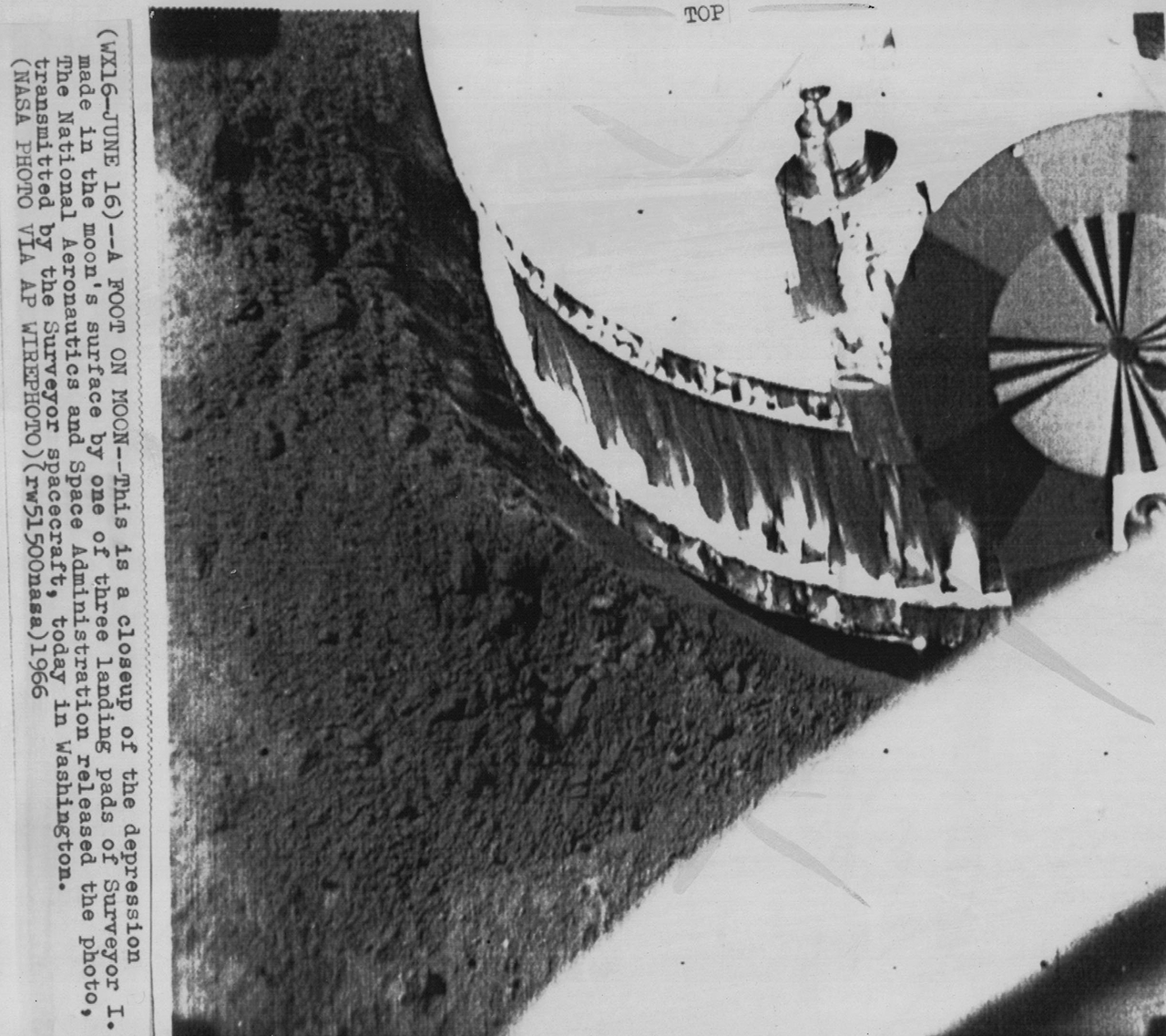
Photo: Closeup view of the depression made in the moon's surface by one of the three landing pads of Surveyor 1. June 16, 1966.

1965-08-11 USA Atlas-Centaur 6

"SpaceCraft" Centaur 6 launch cover cancelled at Cape Canaveral on August 11, 1965. Atlas Centaur 6 carried a Surveyor satellite dynamic model and it conducted a direct-ascent test for guidance evaluation. Signed by the Centaur Program Manager, Roll Duff Ginter.

1964-12-11 USA Atlas-Centaur 4

The AC-4 flight (Atlas 146D and Centaur #4) launched on December 11, 1964, at 14:25:02 GMT, carrying a 2,993 kg mass model of the Surveyor spacecraft. It aimed to test propulsion and stage separation, following two weather-related scrubs. The flight marked the first closed-loop operation of the guidance system and included an attempt to recover the payload shroud, which had a balloon designed to release green marker dye into the ocean. Although the shroud was sighted, it sank before recovery. The Atlas and initial Centaur stages performed as expected, but the mission failed when Centaur couldn't restart due to an ill-advised modification that reduced the size of the ullage rockets to save weight. This reduction proved insufficient to settle the propellants, causing venting hydrogen to throw the vehicle into a tumble. After ten orbits, Centaur reentered Earth's atmosphere over the South Pacific on December 12, 1964.

1963-11-27 USA Atlas-Centaur 2

On November 27, 1963, at 19:03:23 GMT, AC-2 (Atlas 126D and Centaur stage #2) launched just five days after President Kennedy's assassination. The redesigned Centaur stage operated smoothly, performing a single burn to achieve a geostationary transfer orbit (GTO) with parameters of 474 x 1586 km, an inclination of 30.4°, and a period of 105.8 minutes, where it remained as of 2021. The insulation panels were permanently attached due to unresolved jettison issues, with vibration data indicating that they would have detached prematurely if not bolted down. The final solution to the panel problem increased the dry mass of the Centaur, reducing its payload capacity. This Atlas-Centaur 2 launch vehicle was used for performance and structural integrity tests, carrying a payload of 4621 kg, including 907 kg of sensors, equipment, and telemetry.

First launch of Atlas-Centaur cover by "Space Craft", postmarked at Cape Canaveral on November 27, 1963.
Photo: The first test flight of the Centaur rocket.
(Reference from Atlas-Centaur)

1962-05-08 USA Atlas-Centaur 1

n October 1961, the first Atlas-Centaur (Vehicle Flight-1: Atlas 104D and Centaur F-1) arrived at Cape Canaveral and was set up at the newly constructed LC-36A. However, technical issues delayed the vehicle's launch for seven months, with the most significant problem being the leakage of liquid hydrogen through the intermediate bulkhead separating the propellant tanks, along with several other issues affecting the guidance and propulsion systems. The vehicle was finally launched at 2:49 PM EST (18:49 GMT) on May 8, 1962, with the aim of conducting a single burn using a partially fueled Centaur. Just under a minute into the launch, the Centaur stage ruptured and disintegrated, causing the Atlas to follow suit within seconds. The failure was attributed to an insulation panel that detached from the Centaur during ascent, causing a surge in tank pressure when the liquid hydrogen (LH2) overheated.


(Reference from Atlas-Centaur)